
PDF to WebP Converter

Upload an SVG, PDF, EPS, or DXF file to convert it to WebP images in seconds.

+Upload your vector

Or drop your vector file here

Why PDF to WebP

Everything a great PDF to WebP conversion should do

Resolution, transparency, compatibility, fidelity, privacy — here is what our renderer does between your upload and your download, and why teams trust it for PDF to WebP work that ships.

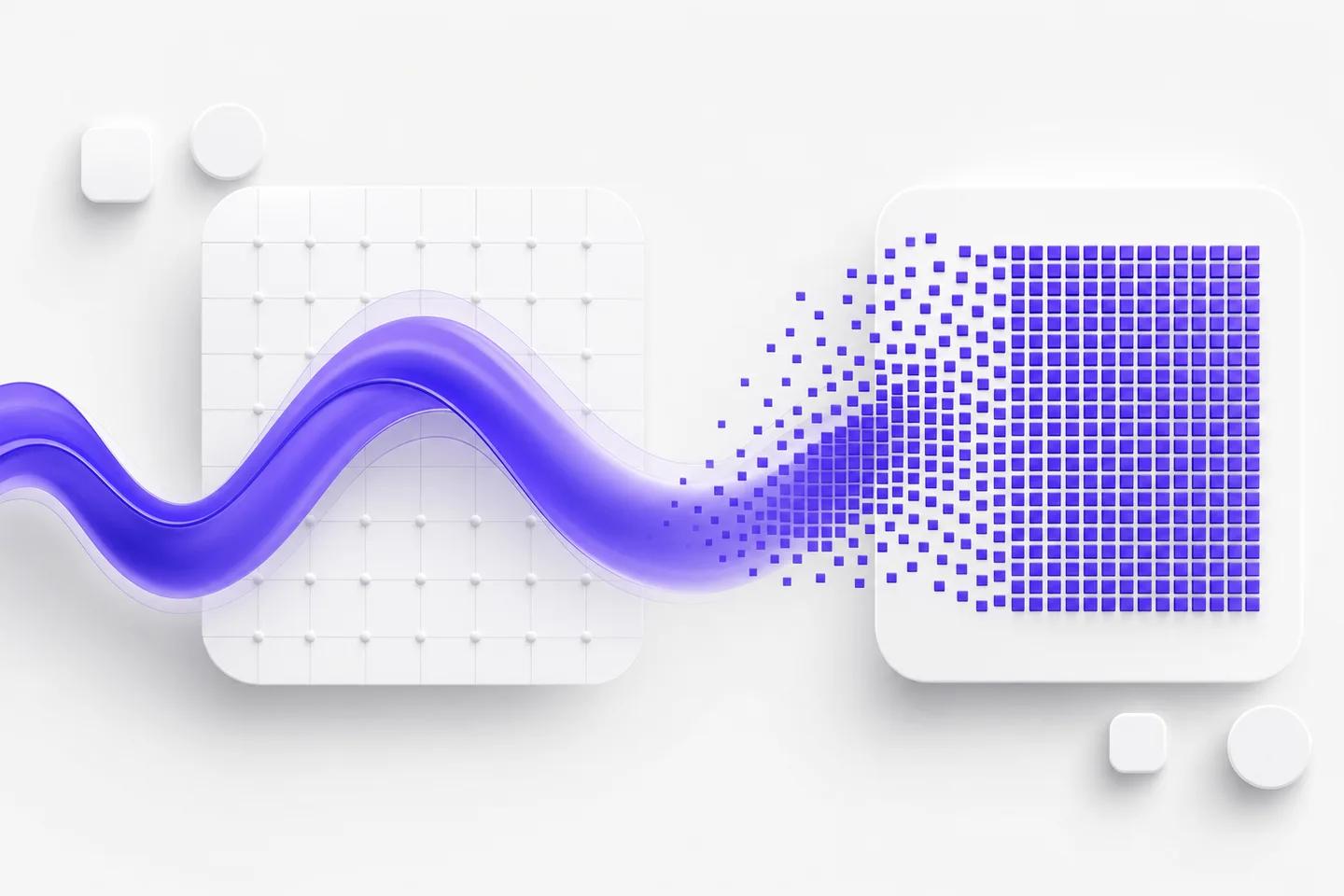
Vector artwork rendered into a crisp pixel grid during PDF to WebP conversion

Pixel-perfect rendering at any resolution you ask for

Rasterizing is only as good as the engine behind it, and PDF to WebP here runs on a full vector renderer rather than a screenshot of your file. You choose the output dimensions and the artwork is redrawn at that exact size, so a 64-pixel favicon and a 4000-pixel hero banner come from the same source with equally clean edges. Curves stay smooth, hairlines stay visible, and type keeps its shape. That control is what makes PDF to WebP safe for retina screens, print placement, and marketplace listings that reject anything soft or upscaled.
Transparent and solid backgrounds compared for PDF to WebP output

True transparency, exactly as you drew it

WebP stores a real alpha channel, so PDF to WebP keeps a transparent background intact — no white box appearing behind your logo when it lands on a colored page. Prefer a solid backdrop? Flatten onto white or a brand color before exporting and the PDF to WebP result ships that way instead. Because transparency is written per pixel, soft shadows, feathered glows, and anti-aliased curves survive without the gray halo that cheap converters leave behind. Drop the file into a deck, a storefront, or an email and it composites cleanly over whatever sits behind it.

The same artwork displayed on phone, laptop, and social cards after PDF to WebP conversion

A file that works everywhere you publish

Vectors make a great master format, but very few platforms display them reliably — which is why PDF to WebP is usually the last step before publishing. WebP is the opposite: far smaller files at the same visual quality. Browsers, phones, email clients, CMS uploaders, chat previews, ad platforms, marketplaces, and slide decks all accept it with no plugin and no conversion warning. Export once at the size you need and the same asset can be pasted into a product page, an ad, or a document without surprises. Running PDF to WebP up front saves the frantic reformatting later.

Layered vector artwork with gradients and masks prepared for PDF to WebP conversion

Complex source files render the way you designed them

A PDF is rarely simple: expect embedded fonts, clipping masks, gradient meshes, blend modes, multi-page documents, and CAD layers nobody documented. Our PDF to WebP renderer handles those instead of silently dropping them, so what you see in your design app is what lands in the WebP. Fonts are resolved, masks are respected, overlapping fills keep their stacking order, and long documents render page by page. That reliability matters most when PDF to WebP runs inside an automated pipeline, where a single missing glyph or lost layer can reach a customer before anyone notices.

Lightning bolt, padlock, and download card representing fast private PDF to WebP conversion

Free, private, and done in a couple of seconds

PDF to WebP conversion here is free, requires no account, and adds no watermark to your download. Files move over an encrypted connection, are used only to render your WebP, and are deleted automatically afterward, so client work and unreleased designs stay private. Everything runs in the browser, which means PDF to WebP behaves identically on macOS, Windows, Linux, ChromeOS, and mobile — no design software to buy, no plugin to update, no IT ticket to file. Most files finish in a couple of seconds, so you can convert, check, and get back to work.

Loved by makers

Teams ship faster with PDF to WebP in their workflow

Storefronts, docs sites, print shops, and freelancers — here is what changed after they moved their PDF to WebP exports over to us.

Our storefront needs flat images rather than vectors, so PDF to WebP happens dozens of times a week. Uploading here beats launching a design app for a single export. The PDF to WebP output is sharp at retina size, the background behaves exactly as expected, and nothing gets flagged by our listing checks anymore.
Beatrice HoffmanBeatrice HoffmanMarketing manager, Vela Foods
I hand artwork to clients who do not own design software, so every delivery ends with PDF to WebP. The files come back crisp, correctly sized, and small enough to email without a warning. Doing PDF to WebP in the browser quietly removed one of the most tedious steps from my week.
Andre WhitfieldAndre WhitfieldPrint production lead, Halden Press
We use PDF to WebP to build preview thumbnails for a documentation site. Gradients, clipping masks, and embedded fonts all render correctly, which was not true of the library we replaced. The PDF to WebP step has needed zero attention since we switched, and that is the highest praise I have.
Jonas LindqvistJonas LindqvistFront-end engineer, Tellwise

PDF to WebP converter

Frequently asked questions

Yes. PDF to WebP conversion is free, with no account, subscription, or watermark. Convert as many files as your normal workflow needs, and use every PDF to WebP download in personal or commercial projects. Nothing useful is held back behind a paywall and nothing is stamped across your finished image.

Choose the size you will actually display, then double it for retina screens. Because PDF to WebP re-renders from vector geometry, a larger export costs you nothing in quality — only file size. For print, aim for roughly 300 pixels per inch of final placement when you run PDF to WebP.

Yes. WebP supports transparency, so PDF to WebP preserves it as drawn, including anti-aliased edges. Prefer a solid backdrop? Flatten onto white or a brand color before exporting. Either way, the PDF to WebP result composites cleanly over whatever background you place it on.

In almost every case, yes. The PDF to WebP renderer resolves embedded fonts, honors clipping masks, and preserves gradient and blend-mode stacking, so the WebP matches your design app. If something unusual slips through, converting a flattened copy of the source normally resolves the PDF to WebP difference immediately.

Yes. Files uploaded for PDF to WebP conversion move over an encrypted connection, exist only long enough to render your download, and are then deleted automatically. They are never sold, published, or used to train models, so unreleased and confidential PDF to WebP work stays exactly that.

Run your PDF to WebP conversion now

Upload a file, choose the size you need, and download a pixel-perfect result — free PDF to WebP conversion with no account, no software, and no watermark.